
Hot Keywords:Used Stone CrusherUsed Ball MillUsed Rotary KilnBall Mill
The slope, filling rate and rotational speed of a rotary kiln are mutually restricted and coordinated, which jointly determine the conveying speed, retention time, heat exchange efficiency and production stability of materials in the kiln. They are the core parameters for the design, operation and adjustment of the rotary kiln. The specific relationships are as follows:
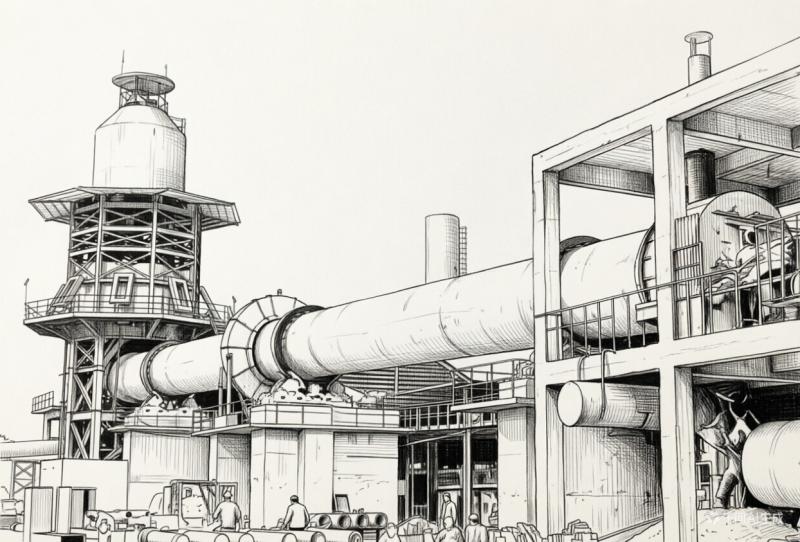
1.1 Slope and Filling Rate
The slope refers to the angle between the kiln axis and the horizontal line, usually expressed as a percentage (for example, 3% means a height difference of 3 cm per meter of kiln length).
- When the rotational speed and feed rate are fixed: the larger the slope, the stronger the downward component of gravity acting on the material along the kiln, the faster the material slides, the less material is retained in the kiln, and the lower the filling rate; on the contrary, the smaller the slope, the higher the filling rate.
- When the target filling rate is fixed: the larger the slope, the higher the maximum allowable feed rate, which can achieve higher output; at the same output, a larger slope corresponds to a lower filling rate.
1.2 Rotational Speed and Filling Rate
The rotational speed is the number of revolutions of the kiln cylinder per minute. A rotary kiln drives materials to tumble and move forward through the rotation of the cylinder.
- When the slope and feed rate are fixed: the faster the rotational speed, the higher the efficiency of the cylinder driving material tumbling and forward conveying, the shorter the retention time of materials in the kiln, and the lower the filling rate; on the contrary, the slower the rotational speed, the higher the filling rate.
- When the target filling rate is fixed: the faster the rotational speed, the larger the material throughput, and the higher the upper limit of output; at the same output, a faster rotational speed corresponds to a lower filling rate.
1.3 Slope and Rotational Speed
These two are core matching parameters for controlling material movement, which jointly determine the conveying speed and retention time of materials.
- When the filling rate and required retention time are fixed: increasing the slope requires a synchronous reduction of the rotational speed, and reducing the slope requires a synchronous increase of the rotational speed, to offset the impact of single parameter changes on material speed and ensure sufficient reaction.
- For production increase and optimization: usually, the slope and rotational speed are moderately increased synchronously, which can improve material throughput without exceeding the filling rate limit, and at the same time enhance the heat exchange efficiency between materials and hot air flow.
| Kiln Type | Common Slope | Common Rotational Speed | Reasonable Filling Rate |
| Cement Clinker Kiln | 3.0%~4.0% | 1.0~3.5 r/min | 6%~12% |
| Lime/Active Lime Kiln | 2.5%~3.5% | 0.8~2.5 r/min | 8%~15% |
| Metallurgical Roasting Kiln | 2.0%~3.0% | 0.5~2.0 r/min | 10%~20% |
Xinmi Kaiyang Furnace Industry Co., Ltd
+86-13676907460
Follow Us
© 2026 Xinmi Kaiyang Furnace Industry Co., Ltd. Site Map


If you have any queries, get in touch today! Don't hesitate. We try to take the extra step for our customer satisfaction.
 English
 Chinese
 French
 German
 Russian
 Italy
Italy Spain
Spain Portugal
 Japanese
 Korean
 Arabic
 Traditional