
Hot Keywords:Used Stone CrusherUsed Ball MillUsed Rotary KilnBall Mill
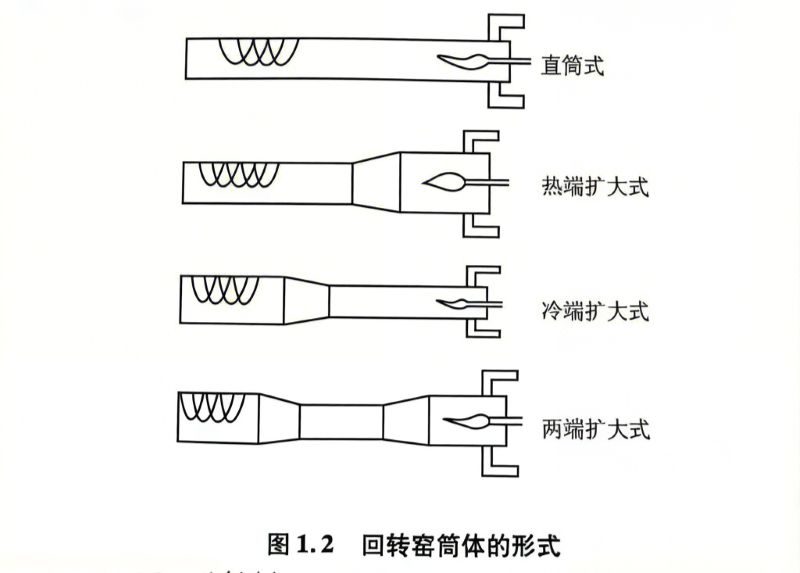
There are four main types of rotary kiln shell: straight cylindrical type, hot end expanded type, cold end expanded type, and double-end expanded type. Each type has its own advantages and disadvantages in terms of structural characteristics, thermal performance, and applicable scenarios, and the appropriate kiln type should be selected based on specific production requirements.
The straight cylindrical type features a simple structure with a uniform shell diameter, which facilitates design, manufacturing, and maintenance. It involves fewer varieties of refractory bricks and accessories, ensures stable operation, and maintains uniform material movement speed and consistent filling coefficient within the kiln. However, it suffers from low thermal efficiency, relatively small heat transfer area, poor heat utilization, limited output, and a narrow application scope, making it unsuitable for processing materials requiring special thermal conditions. It is suitable for small-scale rotary kilns or applications with low thermal requirements, and is commonly used in processes such as reduction, volatilization, and roasting of sulfide concentrates in the non-ferrous metal industry.
The hot end expanded type increases the diameter of the combustion zone (burning zone), thereby expanding its volume, enhancing the kiln's heat generation capacity, improving heat transfer efficiency, and thickening the radiation layer of flame gases. This helps boost output and, for smaller-diameter kilns, reduces the risk of ring formation and extends the operating cycle. Nevertheless, it may have insufficient pre-calcination capacity, a more complex structure, a greater variety of refractory bricks and accessories, and inconvenient maintenance. It is suitable for materials with high firing temperatures, such as periclase and dolomite, and for scenarios where output needs to be increased but preheating requirements are not stringent.
The cold end expanded type expands the drying and preheating zones, enhancing the kiln's preheating capacity, reducing the air velocity at the kiln tail and exhaust gas temperature, minimizing heat consumption and fine dust entrainment loss. It facilitates the installation of heat exchangers, increases the drying heat transfer area, accelerates the evaporation of moisture from slurry, allows for more chain hanging to lower the tail gas temperature, and further reduces wind-blown losses. However, it has a more complex structure, a wider variety of refractory bricks and accessories, and inconvenient maintenance, and is mainly used in long wet-process kilns. It is suitable for long wet-process kilns, especially for processing materials with high evaporation demand and difficult drying, and is conducive to connecting with preheaters to improve overall thermal efficiency.
The double-end expanded type combines the advantages of both hot end and cold end expansion, enhancing both preheating and calcination capacities. The increased filling coefficient in the middle section reduces material flow opportunities, leading to a significant output increase. The constricted middle section also saves some steel, which is highly beneficial for improving production quality. However, it has the most complex structure, posing greater challenges in manufacturing and installation, involving the largest variety of refractory bricks and accessories, inconvenient maintenance, complex management, and higher costs. It is suitable for scenarios demanding high preheating and calcination capacities, especially for large-scale rotary kilns and production lines that require a balance between preheating and calcination processes.
Xinmi Kaiyang Furnace Industry Co., Ltd
+86-13676907460
Follow Us
© 2026 Xinmi Kaiyang Furnace Industry Co., Ltd. Site Map


If you have any queries, get in touch today! Don't hesitate. We try to take the extra step for our customer satisfaction.
 English
 Chinese
 French
 German
 Russian
 Italy
Italy Spain
Spain Portugal
 Japanese
 Korean
 Arabic
 Traditional