
Hot Keywords:Used Stone CrusherUsed Ball MillUsed Rotary KilnBall Mill
The inclination of a rotary kiln (typically 3%–5%, corresponding to an angle of ~1.5°–3° between the kiln axis and the horizontal line) is a core design prerequisite for continuous production and efficient sintering. Its primary functions are as follows:
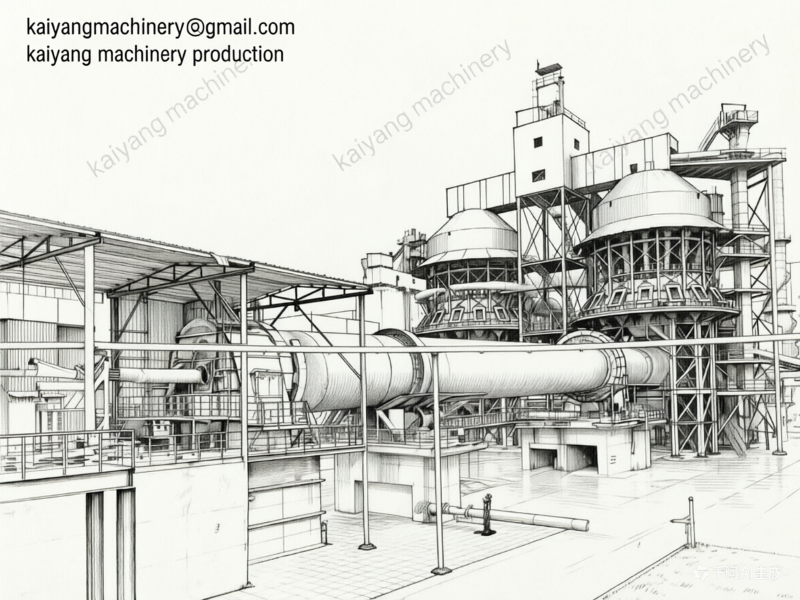
1. Enabling Continuous Material Conveyance and Controlling Residence Time
- Materials inside the inclined cylinder slowly move toward the lower end (discharge end/hot end) under the combined action of gravity, friction, and kiln shell rotation.
- Inclination and rotational speed together determine the residence time of materials in the kiln: greater inclination or higher rotational speed accelerates material movement and shortens residence time, and vice versa.
- Without inclination, materials would stagnate in the kiln, making it impossible to realize the continuous production flow of feeding, calcining, and discharging.
2. Enhancing Heat Transfer and Uniform Sintering
- The inclined structure causes materials to continuously tumble and cascade as the kiln rotates, forming a loose material bed that significantly increases the contact area between materials and high-temperature flue gas, strengthening all three modes of heat transfer: convection, radiation, and conduction.
- Repeated exposure to high-temperature flue gas during material movement avoids local overheating or under-calcination, ensuring uniform sintering quality.
- A horizontal kiln would lead to material accumulation at the bottom, resulting in extremely low heat transfer efficiency and frequent "under-burning" or "over-burning" defects.
3. Optimizing Thermal Process and Countercurrent Heat Exchange
- Rotary kilns adopt countercurrent heat exchange between materials and flue gas: materials move from the upper end (cold end/feed end) to the lower end, while high-temperature flue gas flows from the lower end to the upper end.
- Inclination ensures stable countercurrent contact, enabling gradual heat transfer: materials sequentially undergo drying, preheating, calcining, and cooling as they move, while flue gas gradually cools before emission, maximizing heat utilization efficiency.
- Without inclination, a stable countercurrent heat exchange regime cannot be established, leading to a sharp decline in thermal efficiency.
4. Improving Equipment Operation and Maintenance Performance
- Inclination promotes uniform material distribution in the kiln, reducing the risk of malfunctions such as ring formation and coating, and extending the service life of the kiln lining.
- The inclined structure facilitates the installation and maintenance of the kiln lining (refractory bricks) and ensures better fitting of sealing devices at the kiln head and tail, minimizing air leakage and material leakage.
- Mechanically, inclination distributes loads on support rollers and riding rings more evenly, reducing wear and prolonging the overall service life of the equipment.
5. Flexibility to Adapt to Different Processes
- Inclination can be adjusted to match material characteristics across different processes (e.g., wet-process kilns, dry-process kilns, non-ferrous metal roasting kilns):
- For high-moisture, easily adhesive materials, increasing inclination accelerates material movement to prevent adhesion.
- For materials requiring long calcination time, reducing inclination and rotational speed extends residence time.
Xinmi Kaiyang Furnace Industry Co., Ltd
+86-13676907460
Follow Us
© 2026 Xinmi Kaiyang Furnace Industry Co., Ltd. Site Map


If you have any queries, get in touch today! Don't hesitate. We try to take the extra step for our customer satisfaction.
 English
 Chinese
 French
 German
 Russian
 Italy
Italy Spain
Spain Portugal
 Japanese
 Korean
 Arabic
 Traditional