Ball mills are widely used in mining, cement, new building materials, chemical industry, metallurgy, and other industries, and different industries and production processes involve different materials to be ground. These materials vary greatly in hardness, water content, purity, and particle size requirements, which directly determine the performance requirements of the ball mill. Therefore, when choosing a Second-hand ball mill, it is necessary to fully consider the characteristics of the materials to be processed, so as to select equipment that matches the material characteristics, maximize grinding efficiency, reduce energy consumption, and ensure the quality of the finished product.
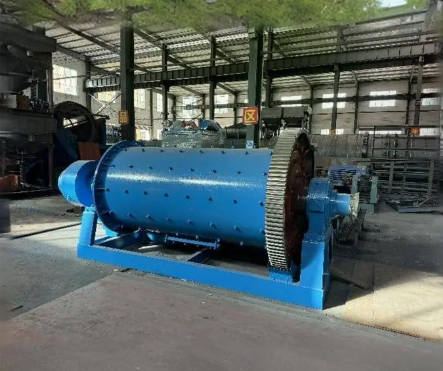
For high-hardness materials such as quartz, granite, iron ore, and copper ore, which require greater impact force and grinding strength to achieve effective crushing and grinding, you need to choose a Second-hand ball mill with high power, high rotating speed, and thick cylinder liner. Such equipment can provide sufficient impact energy to break the hard materials, and the thick liner can resist wear, extending the service life of the cylinder. At the same time, it is recommended to choose a model with a larger cylinder diameter, as the larger diameter can increase the falling height of the steel balls, enhancing the impact force on the materials. For soft materials such as limestone, coal, gypsum, and talc, which have low hardness and are easy to grind, a conventional Second-hand ball mill model can meet the production requirements; there is no need to pursue excessive power and rotating speed, which can effectively save energy consumption and reduce operation costs. For materials with high water content, such as wet coal, clay, and ore slime, a wet-type Second-hand ball mill is more suitable. The wet-type ball mill can mix materials with water for grinding, avoiding material agglomeration and blockage of the grid plate, and ensuring smooth operation of the equipment. For materials with high purity requirements, such as food raw materials, pharmaceutical raw materials, and electronic materials, it is necessary to select a Second-hand ball mill with a liner made of corrosion-resistant, pollution-free, and high-purity materials (such as stainless steel, ceramic, etc.). This can avoid the liner material mixing with the ground materials, ensuring the purity and quality of the finished product. In addition, for materials that require ultra-fine grinding (such as powder coatings, fine chemicals, etc.), it is necessary to choose a Second-hand ball mill equipped with a grading system, which can control the particle size of the finished product more accurately, meeting the special production requirements. Matching the Second-hand ball mill with the material characteristics is the key to improving production efficiency and product quality, and also an important way to reduce unnecessary losses.




 English
 Chinese
 French
 German
 Russian
 Italy
Italy Spain
Spain Portugal
 Japanese
 Korean
 Arabic
 Traditional