
Hot Keywords:Used Stone CrusherUsed Ball MillUsed Rotary KilnBall Mill
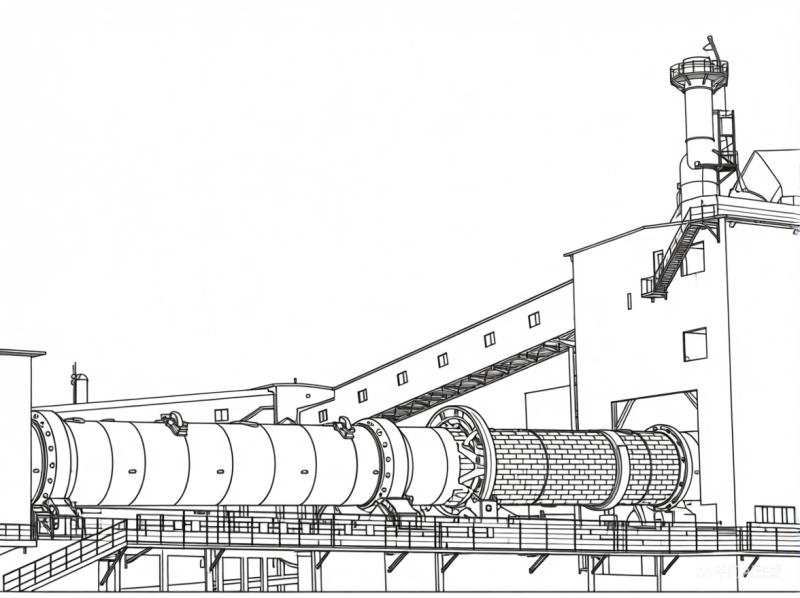
1. Cylinder Shell
Manufactured from low-alloy high-strength steel plate by rolling and welding, with an inclination angle of approximately 3.5% and rotating speed ranging from 0.5–3 r/min. The interior is lined with zone-specific refractory linings: magnesia-iron spinel bricks or direct-bonded magnesia-chrome bricks for the burning zone, high-alumina bricks for the transition zone, and refractory castable at the feed end, forming a protective kiln coating capable of withstanding a calcination temperature of 1450℃.
- Reinforcing rings are welded externally, with riding rings (tyres) mounted on the shell;
- Primarily supported by a three-support configuration;
- Fabricated in sections and assembled on-site.
2. Support & Alignment System
- Riding Rings (Tyres): Fitted around the cylinder shell via backing plates and saddles to transmit the full load of the kiln.
- Support Roller Assemblies (3 supports, 6 roller units): Equipped with double-row self-aligning roller bearings and forced lubrication, bearing the weight of the riding rings.
- Hydraulic Thrust Rollers: Control axial movement of the cylinder shell to compensate for thermal expansion and contraction, preventing end-face wear between riding rings and support rollers.
- Foundation Base: Consists of concrete and steel structure, leveled by secondary grouting.
3. Drive System
- Main Drive: Variable-frequency motor + hardened gear reducer + pinion + girth gear.
- Auxiliary Drive: Enables slow rotation during main power failure to avoid thermal bending of the cylinder shell.
- Speed and torque monitoring with closed-loop speed control.
4. Kiln Outlet System (Discharge End)
- Kiln hood lined with high-strength wear-resistant castable, multi-channel pulverized coal burner (coal injection pipe with adjustable flame profile).
- Inspection ports, infrared temperature and pressure measuring points, kiln outlet seal (scale-type + graphite block composite seal).
- Connected to a grate cooler to recover secondary air for combustion; clinker discharges from the kiln outlet into the cooler.
5. Kiln Inlet System (Feed End)
- Kiln inlet chamber, feed chute and feeding duct.
- Kiln inlet seal (flexible seal to prevent air ingress and dust leakage).
- Connected to preheater and calciner; raw meal enters from the kiln inlet and exchanges heat countercurrently with high-temperature flue gas.
6. Sealing System
Composite sealing system at both kiln inlet and kiln outlet (scale-type, graphite or pneumatic seal) with adaptive performance under thermal conditions. Air leakage rate is controlled within 1%–2%, preventing cold air ingress and hot flue gas and dust emission, maintaining stable negative pressure inside the kiln.
7. Auxiliary Systems
- Lubrication System: Centralized oil station providing forced lubrication and cooling for support rollers, reducers and gear meshing surfaces.
- Cooling System: Circulating water cooling for bearings and thrust rollers.
- ECS / PLC Intelligent Control System: Remote monitoring, alarm, interlock protection and automatic parameter adjustment.
Xinmi Kaiyang Furnace Industry Co., Ltd
+86-13676907460
Follow Us
© 2026 Xinmi Kaiyang Furnace Industry Co., Ltd. Site Map


If you have any queries, get in touch today! Don't hesitate. We try to take the extra step for our customer satisfaction.
 English
 Chinese
 French
 German
 Russian
 Italy
Italy Spain
Spain Portugal
 Japanese
 Korean
 Arabic
 Traditional